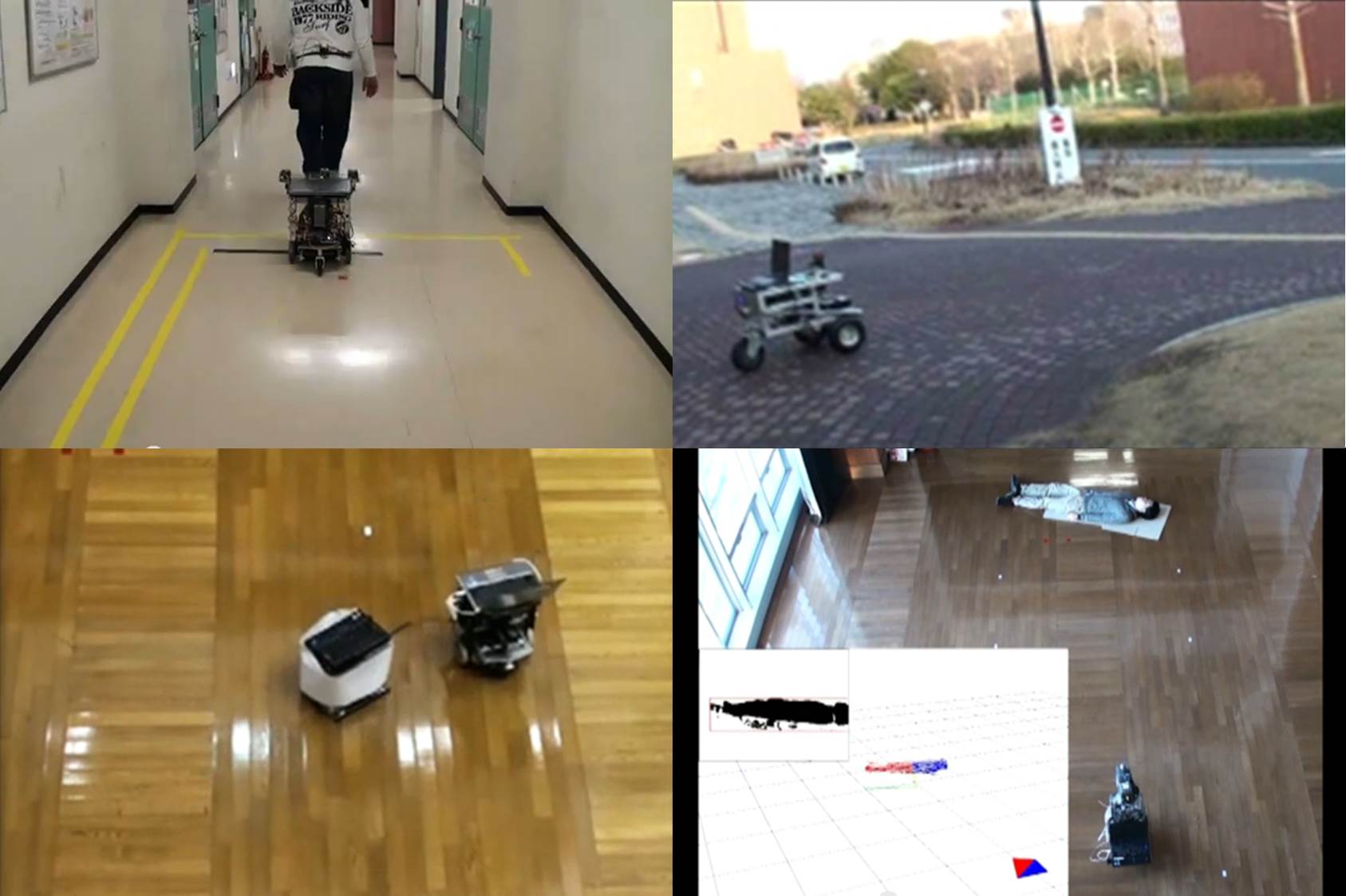
In order to achieve autonomous navigation in the environment assigned, the subject environment is divided into sidewalk and junction section with suitable navigating method devised respectively, which can be switched to one another during navigation. The sidewalk section is an area of which the surface can be recognized by a URG sensor and along which enables autonomous navigation. Meanwhile the junction section is an area in which the robot travels with path planning navigation using data from the URG sensor as well as a 2D map provided in advance. In this experiment, excluding the off-campus section, the navigation method is succeeded for a distance of 3.5km out of the 4km sidewalk.
A system which measures the number of people in a designated area is constructed. With just one URG sensor, and reflective lights from the mirror surfaced tape pasted on the surrounding wall, the system is built insusceptible to error of measurement due to blind spots. The left side shows the image taken from a camera located on the the ceiling. On the top right shows the data measured where '+' represents the sensor location, red represents data obtained directly from the sensor, while blue represents data obtained from the reflections of the mirror surfaced tape on the wall. The bottom right is the result after noise removal and segmentation, with the blue circle representing humans extracted from the data.
With a basis of Distance Transform on a two dimensional plane grid, an algorithm is constructed to make the robot move as closely as possible to the designated path by varying the weights of grids which are not on the designated path. On the left shows the robot motion with the orange line on the ground as the preset designated path. On the right shows the avoidance route, where the green line is the preset designated path, light blue represents the obstacles which are detected by the URG sensor, red is the calculated avoidance route, yellow an expanded red path on the area with no obstacles nearby, and blue represents the path which the robot should move on. The robot motion where obstacle avoidance is executed while staying closely to the designated path is achieved.
The navigation path is given to the robot in advance. Then the self localization of robot is corrected by comparing the URG sensor data of the environment recorded during motion preparation stage and during run-time. (Due to the correction of self-localization, the robot halts temporarily.) In the movie, the robot patrols around the building for three rounds while avoiding obstacles such as bicycles.
In order to let the mobile robot move between floors, recognition of operation display panel such as buttons of elevator seen for the first time has been achieved. After getting into an elevator, the surrounding image of the elevator is taken with a pan-tilt camera, went through image processing and number recognition to locate and recognize the operation display panel. Then the by checking the brightness of the button of the target floor, it is known whether the button is already pushed or not. Then when the light of the button is confirmed to be turned off, the robot will get off the elevator.
The robot segments the URG sensor data and locates the human feet, finds the center of the segment, and move towards the center of segment with a speed proportioned to the distance from the center of segment. Besides, it can avoid obstacles using potential force, where the segments other than the pair of legs will be imposed with repulsive vector, and attractive vector on the human feet. As an extra, the travelled distance, average speed and current speed are displayed on a graph.
A regenerative brake and regenerative energy drive system is attempted to move the robot without any battery to power its motors. In this demonstration, when the robot slides down the slope it will be able to avoid obstacle while sliding down. Besides, if it is pushed from behind manually, it will avoid obstacles by changing its own direction while moving.
While thinking of the usage of reflection intensity, the fact that Roboken members like coke cooks up the idea of bottled coke recognition. Coke is black in color in general thus it is weaker in laser reflection intensity compared to other drinks so this point is used for recognition. After starting up the robot, it will recognize the bottle coke among other drinks set on a specific location, and delivers the coke. The other drinks are unneeded in Roboken so it will clean them up after the coke delivery.
This is a robot which scans 3D form of human and things. With the URG sensor installed vertically and horizontally, the robot goes around a person once and acquire the 3D information of the person. Then from the data, the height, weight and BMI can be estimated and the person will be assessed as being slim or overweight.
The robot moves in a narrow passage which is surrounded with walls at both sides, similar to the 'L crank' test in driving school. The width of the passage is set as 40cm for the robot with width of 35cm. With the URG sensor detecting the distance of the walls on both sides, the robot moves forward without colliding into the walls. When it is at a turn, it will decide which way to turn to, and goes forward and backwards repeatedly to adjust its position while turning gradually. This demonstration reminds one of the scene at a driving school.
The robot is a small wheeled inverted pendulum robot. When the robot tilts and seems to collapse, it will move forward or backwards to balance itself while advancing to the front. The motor control system making the robot stand and proceed onwards is accomplished by adjusting the output of motor with the input from rotary encoder and gyro sensor. The robot can move up and down a plane surface with low inclination as well. AA battery is used as the power source of the robot.