Three Pillars of Research
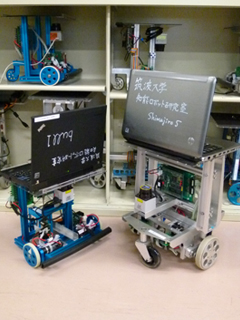
Our lab's research activities are broadly divided into the following three themes:
- Realization of high-level autonomous robot behavior based on task-oriented approach and system integration
- Development of new fundamental technologies for intelligent mobile robots
- Development of YAMABICO autonomous mobile robots as our research platform
There are overlaps between these three pillars in research contents and fields. However, this division gives clarity to the goals and personalities of each research theme, and helps us avoid a common pitfall in robotics research: to not have a clear objective.
Research topics we are currently advancing, or having an interset in, are as follows:
Specific Research Topics
1. Realization of high-level autonomous robot behavior
based on task-oriented approach and system integration
- Autonomous navigation in real indoor and outdoor environments
- Autonomous robots working in cooperation with humans in human environments
- Remote control of mobile telepresence robots via Internet
- Localization and mapping in unknown environments
- Multi-robot cooperative search in a given environment
- Conceptual design of the rover for moon inspection
- Robotic security and surveillance systems
- Object manipulation using a mobile manipulator
- Autonomous mobile robots for construction and agricultural tasks
2. Development of new fundamental technologies for intelligent mobile robots
(a) Design and Control of Autonomous Robots
- Functional architecture and design guideline for autonomous robots
- Controller hardware and software - miniaturized low power controller/distributed controller
- Description method for robot tasks and behaviors, and programming language for robot behaviors
- Development environment for robot programming
(b) Mechanism and control of wheeled mobile robots
- Programming language and system for locomotion control
- Control technologies for miniaturized mechanical systems
(c) Sensors and Environment recognition
- Develoopment of 2D and 3D laser range scanners
- Environment and obstacle recognition with active vision/2-camera stereo vision for robotic systems
(d) Localization of mobile robots
- Localization based on fusion of odometry and external sensor data
- Extended Kalman Filter/GPS/Landmark-based localization
- Automatic map data matching for localization
(e) Environment recognition and mapping through movement
- Simultaneous Localization and Mapping (SLAM)
- Environment recognition and mapping using laser range scanners
- Machine Learning approach for environment recognition
(f) Human interface and remote control technologies for mobile robots
- Novel vehicle control interfaces
- Visualization systems for robot internal states and its surrounding environments
3. Development of YAMABICO autonomous mobile robots as our research platform
(a) Wheeled mobile robots with standard functions
- Standard motion control language and system
- Environment model maintenance and path planning subsystems
- Localization subsystem
- Multi-robot communication network